
A guide to neurodiversity and sensory processing and profiles, written by GEC Intern and PhD Researcher, Swane Parchment (Kingston University)
What the Difference between Sensory Processing and A Sensory Profile?
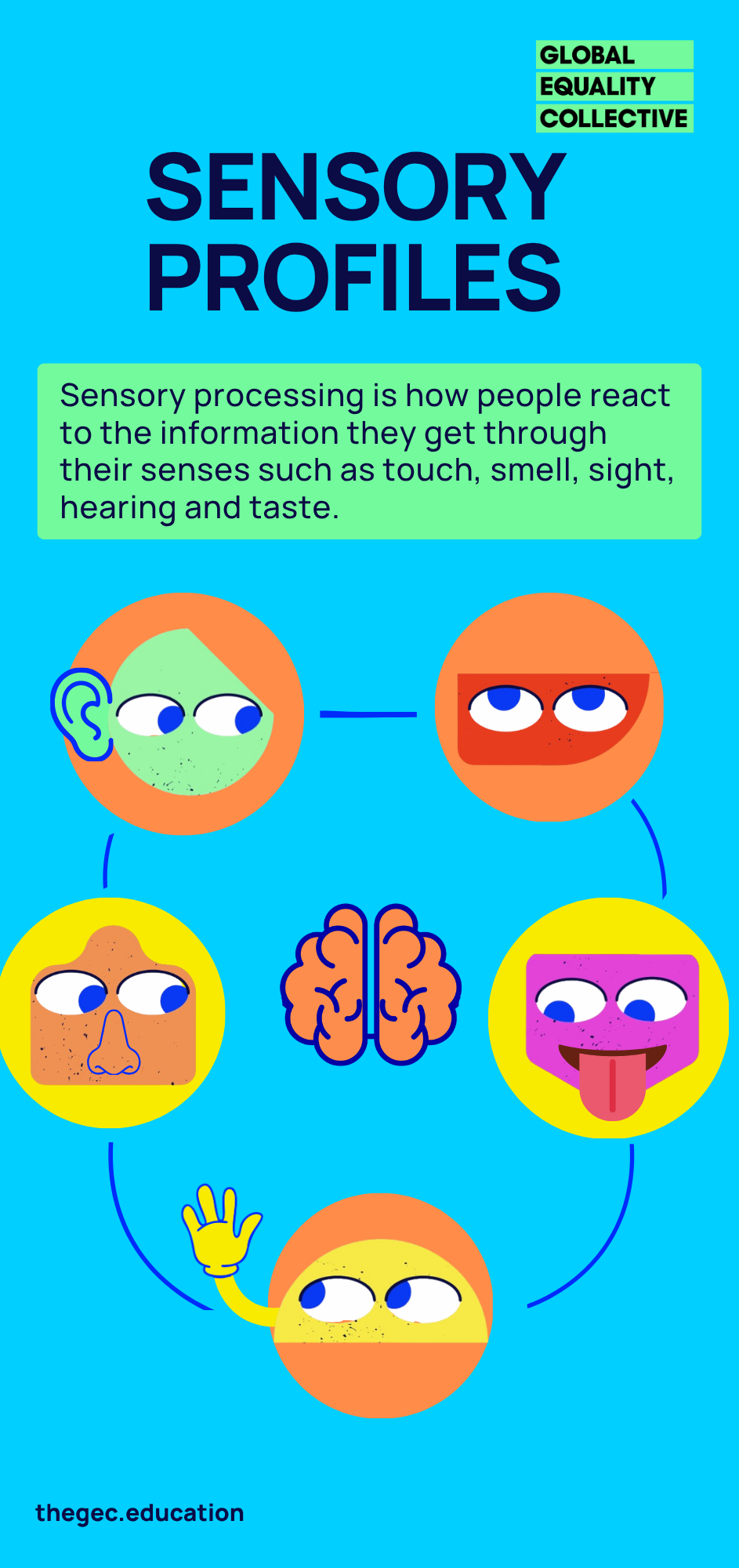
Sensory processing is how people react to the information they get through their senses.
Research states sensory processing involves intaking and processing information through the senses that includes sensory processing differences (Dunn, 1999; Tomcheck & Dunn, 2007; Wang et al., 2019). This includes the five main senses: touch, smell, sight, hearing and taste. As many as one in three of us experience sensory processing needs and not all of this is linked to being neurodivergent.
What Does the Research Tell Us?
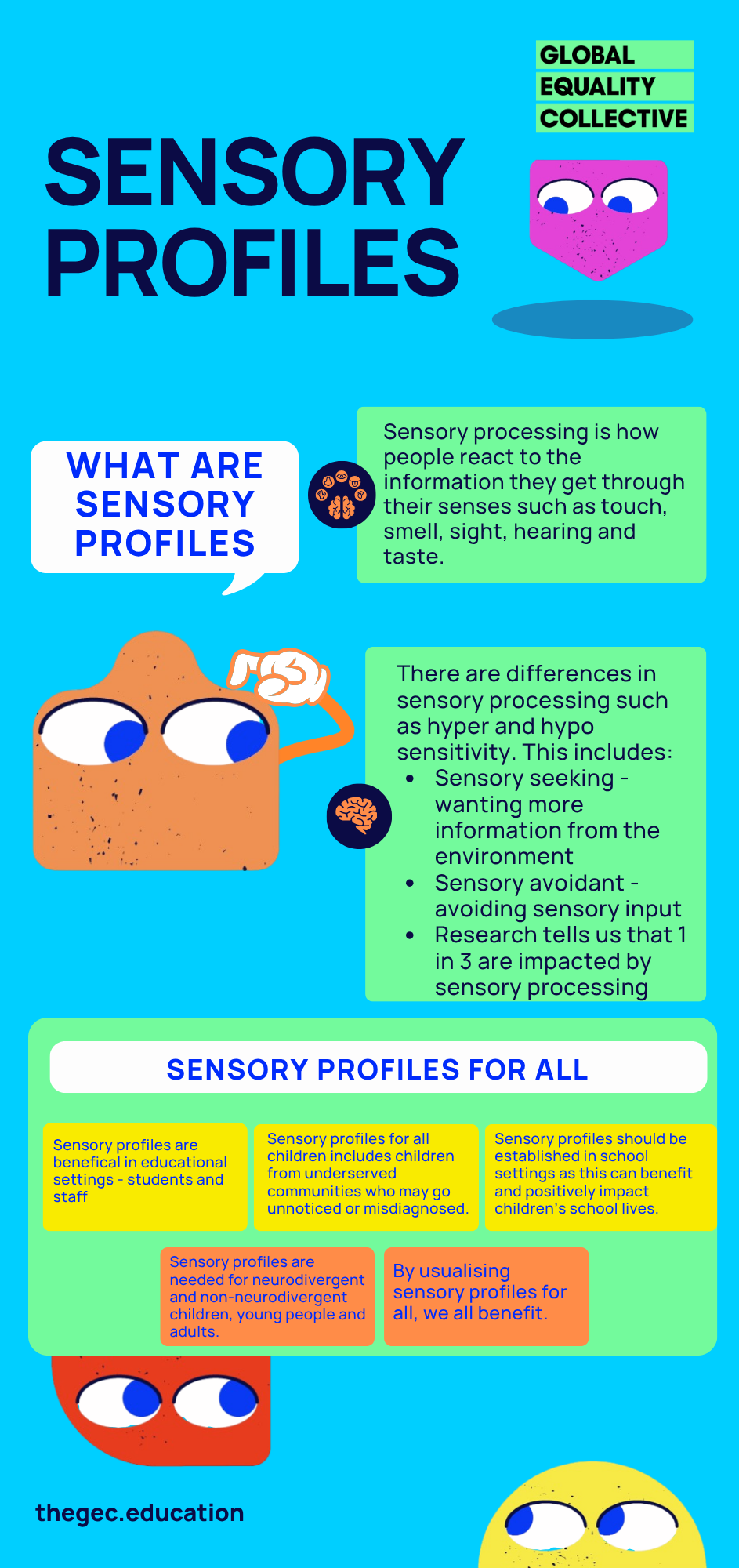
The sensory processing differences may result in different sensory profiles. There are also differences in sensory processing such as hypersensitivity and hyposensitivity. Within research, this includes sensory-seeking, attempting to gain more information from the environment and sensory avoidant which is avoiding sensory input (Ashburner, Ziviani & Rodger, 2008; Scaaf et al., 2014; Mills, Michail & Bye, 2020; Crasta et al., 2020).
These sensory processing differences are evident for children who may have to navigate educational settings such as in primary and secondary schools. Schools should be aware of some sensory processing differences neurominority and neuromajority children may experience with the five senses, and what they can do to support them to ensure a neuroinclusive environment for all children. For example, school canteens can have loud noises, colliding smells of food and cleaning products, and overwhelming sights of posters on the walls and/or bright lighting.
Schools can help support their students by having a quiet table (or quiet tables if there are more children that need quiet tables) in the canteen, having the students go before the rooms get too busy, or have them stand at the beginning/ end of the line at breaks, as well as providing fidget toys or a trusted friend or adult.
For primary schools, the classroom and activities can be an environment that has visual, auditory and tactile sensory input. While some primary school students/learners may be stimulating and keeps them engaged, for some this may be an overwhelming and an exhausting experience. Primary schools can help support their students by providing quiet areas and monitoring the noise and lighting in their classrooms.
For secondary schools, the school environment is equally complex and stimulating, but movement across sites can be an issue as can dealing with unknown adults and learners from different phases. Secondary schools can support their students by providing quieter or less busy spaces/ rooms designated safe areas, adjusting their timetables to allow students to leave their lessons earlier to avoid the crowded hallways between lessons and/or allowing noise-cancelling headphones for students.
There are ways for both primary and secondary schools to successfully support their students.
This includes: providing breaks, having the children leave the classroom first or last at the end of the lesson, preparing the children for any sensory input beforehand and using social stories or videos in advance. You can incorporate movement breaks for students that need more sensory input such as movement, arranging the seating plan to accommodate the sensory profiles of the children (such as seating children with hypersensitivity either away or near one another based on their preferences). We also advise using visuals at the front of the class to map out the day, and/or having a piece of material such as rag, handkerchief, pocket square with a smell or scent that the child may like.
The research around sensory processing has primarily focused on neurominority people, especially autistic people (Corbett, Muscatello & Blain, 2016; Mills, Chapparo & Hinitt, 2020) but we are learning that all of have preferences when it comes to our sensory profiles.
The Need for Sensory Profiles for All
We believe that the conversation should be shifted from sensory processing being just for neurominority children, young people and adults which can be harmful and discriminatory, instead be towards striving for inclusion. The normalising of sensory profiles for everyone and encouraging understanding of the differences within sensory processing is needed for all especially in educational settings – including for students and staff. This supports belonging in schools and enables all to thrive.
In a research study, Litte et al. (2017), caregiver-report questionnaires were used with 1,132 autistic and neuromajority children aged 3-14-years-old. The results of this study showed that autistic children and non-autistic children displayed sensory processing across five subtypes. This study included neuromajority children as a focus as opposed to being matched controls and showed the need for more sensory processing research and profiles for neuromajority children.
The difference in sensory processing in neurominority people is diverse and individualistic (Little et al., 2017; Wang et al., 2019). Similar to the differences within sensory processing in neurominority people, research has shown that neuromajority children and young people experience sensory processing and experience differences within sensory processing that is individualistic (Little et al., 2017; Mills, Michail & Bye, 2020).
Al-Heizan et al. (2015), a research study, found that neuromajority children displayed movement sensitivity, auditory domains, under-responsiveness, sensory-seeking and tactile sensitivity. This study placed emphasis on the central nervous system in sensory processing. Also, this study highlighted that neuromajority children also have sensory processing differences that require sensory profiles. In another study, Dwyer et al. (2020), the parents of 213 children, 132 being neurominority and 81 being neuromajority, completed caregiver-report questionnaires and cognitive and communication assessments. This study established the sensory processing in neuromajority children and the need for neuromajority children to also have sensory profiles.
Research such as these help show the need to shift the notions of neuromajority children from being matched controls used as a ‘baseline’ as to not be exclusionary and discriminative, and should instead be neuroinclusive. It is necessary to address the differences within sensory processing for all children and how this may be a benefit within education settings and in home settings.
Not having sensory profiles for all students may be a contributing factor in the heterogeneity in neurominority children, and the lack of a deeper understanding of sensory processing overall. Sensory profiles for all children, neurominority and neuromajority, within research and the general population is needed.
But the conversation of diversity and inclusion within sensory processing must also include the kaleidoscope of all children – including children from underserved communities. In the discussion of sensory processing and the differences in sensory processing, it is important to address how sensory processing may present in children in underserved communities, and that these profiles may go unnoticed due to systemic issues and disparities such as racism, healthcare access and cultural biases (Trujillo, Pratt & Markides, 2025; Kirby et al., 2022). It is possible that the sensory processing differences may be universal across underserved communities. Although it is important to not treat each underserved community homogeneously. Underserved communities face barriers, and so children from these communities are most likely under-identified or misdiagnosed (Cisneros, 2018; Trujillo, Pratt & Markides, 2025; Kirby et al., 2022).
In terms of sensory profiles for all children, research tells us the need for sensory profiles should also be established in education settings. School environments are a place for sensory experiences with such aspects as school bells, art projects on the walls, bulletin boards, distracting smells in the classrooms or hallways or not noticing these smells bother others and crowding in the hallways. Sensory processing differences means sensory experiences are directly linked to the school experience of children, including impacting their learning (Little et al., 2017; Mills, Michail & Bye, 2020; Mills, Chapparo & Hinitt, 2020; Howe & Stagg, 2016). Howe and Stagg (2016) found that touch, smell and vision produced positive and negative experiences for autistic children. In this study, for example, found that the children with sensory sensitivity impacted their learning which is, in part, due to their negative sensory experiences. In another study, Butera et al. (2020) found that sensory processing differences negatively impacted school performance in autistic children. By finding solutions that help both neurominority and neuromajority children in their education and home settings such as adapting the environment for the children as opposed to forcing the children to adapt to their environment, could lead to combating stress and anxiety (Dunn, 1999; Dwyer et al., 2020; Gomez et al., 2021). That is, providing sensory profiles for all children in education settings has benefits and positively impacts children’s schools lives and also could be the case for their home lives.
Latest Research: Neurodiversity in Mainstream Schools (BERA)
The British Educational Research Association (BERA) published a series of reports, funded by the Kusuma Trust, establishing evidence-based approaches to improving neurominority young people’s educational experience in mainstream settings and academic attainment. The report’s findings give evidence-based guidance to support inclusion, engagement and life chances for policymakers, school leaders and practitioners.
The findings of the four studies conducted in schools, colleges or informal learning environments highlights the need to instead of creating new and complicated interventions, to rethink how education is both designed and delivered. The evidence suggest that there is a need to for educational systems to be more neurodiversity-informed including:
Moving from deficit-based to strengths-based approaches
Greater recognition of non-formal and creative learning environments
Investment in teacher development and cross-sector collaboration
Stronger, earlier support for transitions beyond school
Embedding student voice in policy and practice
Result? Sensory Profiles Should be for All
Leaders, local authorities and schools can help create inclusive environments by introducing sensory profiles for all students and learners - neurominority and neuromajority in schools.
Schools can implement teaching about sensory processing differences. Leaders can also inform parents and carers about sensory differences and how to navigate them so they learn not just potentially about their own children but also about the other children at the school - they may also learn about their own sensory processing differences!
Sensory profiles are needed for neurominority and neuromajority people and by usualising them and making them normal and natural for all, we all benefit.
If you would like to speak to us about this or anything related to inclusion, please get in touch here.
References
Ashburner, J., Ziviani, J., & Rodger, S. (2008). Sensory processing and educational outcomes in children with autism spectrum disorder. American Journal of Occupational Therapy, 62(5), 564–573. Doi: 10.5014/ajot.62.5.564
British Educational Research Association . https://www.bera.ac.uk/publication-series/neurodiversity-in-mainstream-schools-grant-programme-reports
Butera, C., Ring, P., Sideris, J., Jayashankar, A., Kilroy, E., Harrison, L., Cermak, S., & Aziz-Zadeh, L. (2020). Impact of sensory processing on school performance outcomes in high functioning individuals with autism spectrum disorder. Mind, Brain and Education, 14(3), 243-254. Doi: 10.1111/mbe.12242
Cisneros, Steve Garcia (2018). Self-Compassion and Sensory Processing Sensitivity among Sexual Minorities: A Minority Stress Framework. University of Illinois Chicago. Thesis. https://hdl.handle.net/10027/22952
Corbett, B., Muscatello, R. A., & Blain, S. D. (2016). Impact of sensory sensitivity on physiological stress response and novel peer interaction in children with and without autism spectrum disorder. Frontiers in Neuroscience, 10(278), 1-9. Doi: 10.3389/fnins.2016.00278
Crasta, J. E., Salzinger, E., Lin, M-H., Gavin, W. J., & Davies, P. L. (2020). Sensory processing and attention profiles among children with sensory processing disorders and autism spectrum disorders. Frontiers in Integrative Neuroscience, 14(22), 1-10. Doi: 10.3389/fnint.2020.00022
Dunn, W. (1999). Sensory profile. San Antonio, TX: Psychological Corporation.
Dwyer, P., Wang, X., Meo-Monteil, R. D., Hsieh, F., Saron, C. D., & Rivera, S. M. (2020). Defining clusters of young autistic and typically developing children based on loudness-dependent auditory electrophysiological responses. Molecular Autism, 11(48), 1-17. Doi: 10.1186/s13229-020-00352-3
Gomez, I. N. B., Calsa, A. P., Esguerra, J. T., Penetrante H. P. J., Porlucas, K., Santos, M. E., Umail, C. B., & Lia, C. Y. Y. (2021). Psychometric properties of the sensory processing and self-regulation checklist: English version. Occupational Therapy International, 3, 1-9. Doi: 10.1155/2021/6658786
Howe, F. E. J., & Stagg, S. D. (2016). How sensory experiences affect adolescents with an autistic spectrum condition within the classroom. Journal of Autism and Developmental Disorders, 46(5), 1656–1668. Doi: 0.1007/s10803-015-2693-1
Kirby, A. V., Bilder, D. A., Wiggins, L. D., Hughes, M. M., Davis, J., Hall-Lande, J. A., Lee, L. C., McMahon, W. M., & Bakian, A. V. (2022). Sensory features in autism: Findings from a large population-based surveillance system. Autism research : official journal of the International Society for Autism Research, 15(4), 751–760. https://doi.org/10.1002/aur.2670
Little, L. M., Dean, E., Tomchek, S. D., Dunn, W. (2017). Classifying sensory profiles of children in the general population. Child Care Health Development, 43(1), 81-88. Doi: 10.1111/cch.12391
Mills, C. J., Chapparo, C., & Hinitt, J. (2020). The impact of sensory activity schedule (SAS) intervention on classroom task performance in studies with autism – a pilot randomised controlled trial. Advances in Autism, 6(3). Doi: 10.1108/AIA-05-2019-0015
Mills, C. J., Michail, E., & Bye, R. A. (2020). A survey of occupational therapists on a new tool for sensory processing. Occupational Therapy International, 1-11. Doi: 10.1155/2020/5909347
Tomchek, S. D., & Dunn, W. (2007). Sensory processing in children with and without autism: a comparative study using the short sensory profile. American Journal of Occupational Therapy, 61(2), 190-200.
Trujillo Tanner, C., Pratt, J., Markides, K. (2025). Sensory Impairments in Minority Populations. In: Bennett, G., Goodall, E. (eds) The Palgrave Encyclopedia of Disability. Palgrave Macmillan, Cham. https://doi.org/10.1007/978-3-031-40858-8_578-1
Schaaf, R. C., Benevides, T., Mailloux, Z., Faller, P. Hunt, J., van Hooydonk, E., Freeman, R., Leiby, B., Sendecki, J., & Kelly, D. (2014). An intervention for sensory difficulties in children with autism: A randomised trial. Journal of Autism and Developmental Disorders, 44, 1493-1506. Doi: doi.org/10.1007/s10803-013-1983-8
Wang, G., Li, W-L., Gao, L., Dai, W., Su, Y-Y., & Zhang, X. (2019). Sensory processing problems and comorbidities in Chinese preschool with autism spectrum disorders. Journal of autism and developmental disorders, 49, 4097-4108. Doi: 10.1007/s10803-019-04125-7
