

Kickstart Inclusion in 90 Days
By Dr Nicole Ponsford, Founding CEO of the Global Equality Collective
Inclusion is a priority for most schools and trusts, but many leaders tell us the same thing: they know they want to improve, yet struggle to turn intention into sustained, measurable change. Competing pressures, limited time and uncertainty about where to start can cause even well meaning inclusion work to stall. This 90 day roadmap is designed to remove that uncertainty, offering a clear, time bound way to move from baseline insight to focused action, while building trust, momentum and shared ownership across your community.
The GEC Platform offers a structured roadmap to build positive, inclusive cultures — no matter where you’re starting from.
After 90 days, schools and trusts have a clear, data-driven understanding of their culture of inclusion and belonging — grounded in staff and student voice. Leadership teams move from insight to action with a focused, evidence-based plan that is transparent, measurable, and tailored to their community. The result is stronger engagement, greater trust, and the foundations for sustainable cultural change.
From setup, through data collection, to insights and initial actions, here’s how we make the most of your first 90 days.
“…the survey is a great starting point for DEI leads in senior leadership to understand their staff body using an intersectional lens. The platform is versatile, and the GEC can support a school in a variety of ways no matter where you are on your DEI journey.”
Zahara Chowdhury, DEI Lead, Beaconsfield High School
Days 1‑14: Setup & Launch
What you’ll achieve
Get up and running quickly with minimal disruption to the school routine.
Leadership and staff begin to understand that the focus on inclusion, belonging, and culture is not just about compliance, it’s a lens.
Establish a culture of transparency and participation right from the start.
How you’ll do it
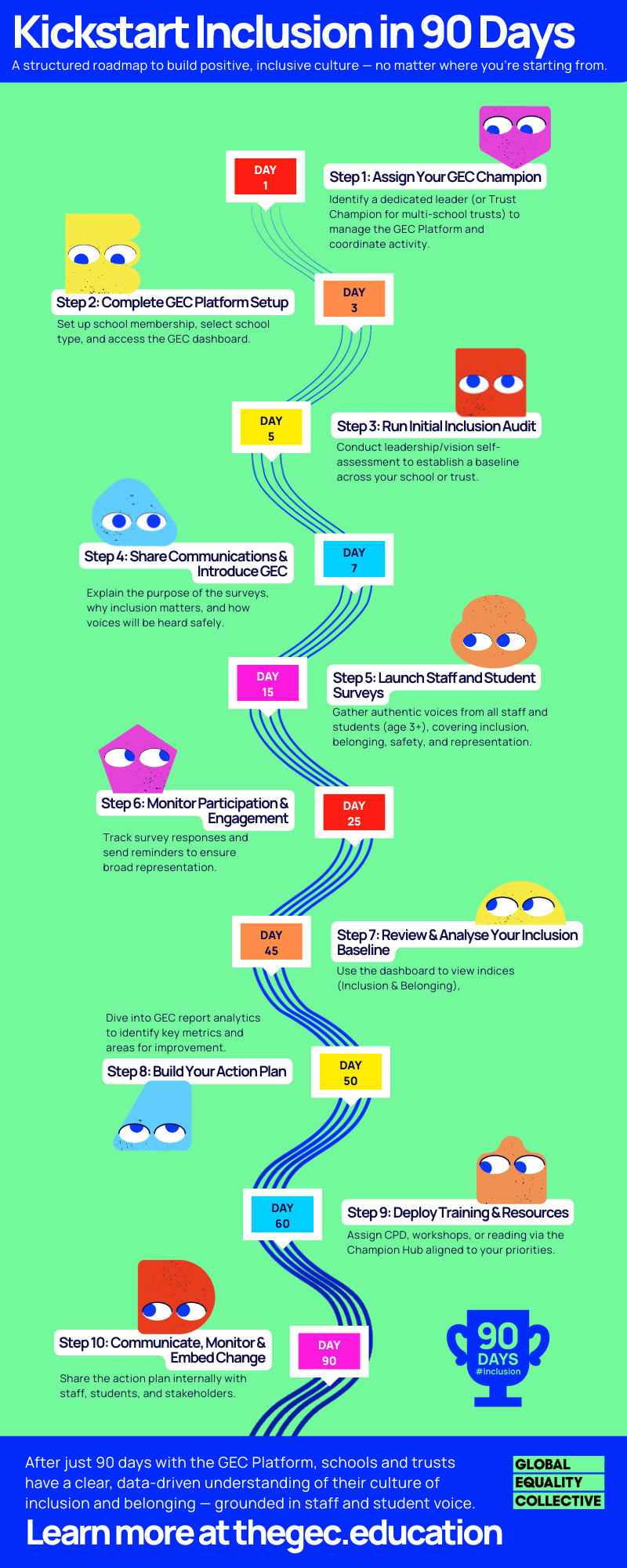
Assign a GEC Champion (or GEC Trust Champion if your setting spans multiple schools). This person will manage the GEC Platform, invite users, and be the primary point of contact.
Complete membership setup: choose your school type (state/maintained; independent; trust/MAT) to ensure correct licensing.
Log into the GEC Platform dashboard (via app.thegec.education) and run your initial Inclusion Audit (leadership/vision self‑assessment) so you establish a baseline. If you are a Trust, all of your settings complete the Inclusion Audit so you can assess consistency and approach from a leadership level first.
Access ready-made communications to share with students and staff about the upcoming surveys. Explain your why - why inclusion and belonging matter, why you want to hear their voices, and why the surveys are anonymous and a safe place for them.
Access the GEC Champion Hub and begin familiarising your team with the resources library (playbooks, training modules, podcasts) to build capacity.
“I have chosen the GEC as a solution as having worked with the organisation before, I know how amazing the resources and staff are and that it will fully support our school in developing inclusive practice.”
Kathie Wade, Headteacher, Coleman Primary School
Days 15‑45: Data Collection & Baseline Analysis
What you’ll achieve:
Gain a reliable, data‑driven baseline of your school’s inclusion and belonging culture.
Dig deeper than surface-metrics. The GEC Platform is built with rigorous research and Kaleidoscopic Data methodology, so you get nuanced insights about your climate.
Staff and students feel their voices are heard — which helps engagement and buy‑in for future action.
How you’ll do it:
Launch the Staff Index across all staff (teaching, support, site, admin, volunteers) using the GEC Platform’s built‑in survey module.
Launch the Student Index (age 3 +) if applicable, capturing student voice on inclusion, belonging, safety, and engagement.
Monitor participation rates and send reminders to ensure good coverage/reflection of views.
As responses come in, use the dashboard to view initial indices: e.g., Inclusion & Belonging, Staff Experience, Leadership & Values, Actions (internal/external).
Begin reviewing your results report: highlight areas of strength and key gaps. For example: how many staff feel they can be their authentic selves; how safe students feel; representation in leadership.
“The GEC platform has been an essential tool in providing us with a starting point for our DEIJ action and areas of urgency… It has fostered better understanding between us as international educators and community members.”
Sientania McNeil, Upper School Learning Support Specialist, ICSA
Days 45‑60: Insights & Action Planning
What you’ll achieve:
You move from what the situation is (data) to what we will do about it (action) in a structured, collaborative, evidence‑based way.
The focus is on sustainable culture change (not just a one‑off audit) because the GEC Platform supports the long‑term journey.
Staff, students and wider stakeholders can see a clear, evidence-based plan emerging from their feedback, which builds trust, ownership and momentum for change.
How you’ll do it:
Dive into the GEC Index and analytics: identify contextual, key metrics (e.g., staff authenticity, student safety, representation, belonging) where you are doing well and where you need improvement.
Use the GEC Platform’s GEC Action Plan tool: each survey item in your report links to GEC Coaching Recommendations (QA‑ed by our in-house Inclusion experts) which you can personalise, assign dates, responsibilities and tick off progress.
Prioritise 2‑3 key focus areas for the next term (e.g., staff professional development in inclusive pedagogy; student voice mechanisms; leadership representation).
“We knew there was lots of work to be done across the trust with EDI, however the GEC Platform has given us our key priorities to focus on where our staff feel the support is needed the most.”
Days 61‑90: Embedding Action & Building Momentum
What you’ll achieve:
Stakeholders see visible commitment and progress, which helps build trust, motivation and momentum.
Begin to embed inclusion-focused practices into everyday school life, moving from isolated actions to consistent habits.
Start to see early signs of impact in confidence, conversations and behaviours around inclusion across your school community.
How you’ll do it:
Deploy relevant training/resources: use the Champion Hub to assign modules of CPD, workshops or reading for (all) staff aligned to your priorities. We can also put you in touch with our Circle Experts to help with CPD
Communicate the action plan internally: share summary insights with staff, students (as appropriate) and stakeholders to build transparency and accountability.
Set a monitoring rhythm: schedule termly check‑ins to track progress, revisit your Action Plan and update for follow‑up cycles and share updates with your communities.
“The platform and collective can support schools with their journey in keeping equality, diversity and inclusion at the forefront.”
Kari Anson, Headteacher, Brays School
And that’s just the start…
The first 90 days set the foundation — once the baseline is established and initial actions underway, you’re ready for ongoing development, measurement and embedding sustainable improvements.
A culture of inclusion and belonging is not optional — it’s a strategic imperative.
Using a specialised framework (rather than generic surveys) means you benefit from research‑based tools and a large collective of experts (the GEC Circle of 400 Inclusion specialists) supporting you.
How to begin
If you are ready to move from reflection to action, the next step is to make this roadmap real in your own context. Schools, trusts and systems use the GEC Platform to support every stage of this 90 day journey, from gathering inclusive insight to developing evidence informed action plans and targeted support. You can start by booking a short demonstration, downloading a practical planning resource, or speaking with a GEC team member about your priorities and timelines. The most effective inclusion work begins with a clear starting point and the confidence to take the first step.